Die Wurzeln der 3. Bombergruppe reichen bis zum Luftkrieg über Frankreich während des 1. WKs zurück. 1939 wurde die Einheit aufgeteilt: Die Hälfte des Personals sollte die neue 27. Bombergruppe bilden, die zur Verteidigung der Philippinen beitragen sollte, während der Rest für zusätzliche Schulungen in den USA bleiben würde.
Die beiden Einheiten vereinigten sich im März 1942 in Australien wieder, nachdem 2 Dutzend Piloten der 27. Bombergruppe bei der japanischen Invasion der Philippinen entkommen waren. Verstärkt durch drei neue Piloten und später RAAF-Co-Piloten und Kanoniere, war ihre erste große Kampfoperation der Royce Raid, ein Überraschungsangriff gegen die Japaner im Herzen der philippinischen Inseln.
Gezwungen, sich an eine unvorhersehbare Nachschublinie anzupassen, flog die Bombergruppe A-24 Sturzkampfbomber, A-20-Bomber, die sie selbst modifizierten, und B-25 mittlere Bomber, die von der niederländischen Luftwaffe erworben wurden. Major Paul I. Pappy Gunn, eine zukünftige Legende der 3. Bombergruppe, war maßgeblich an der Entwicklung einer Spezialversion der A-20 beteiligt, die die Art und Weise veränderte, wie Lufteinheiten die Japaner angriffen.
Im Laufe des Jahres 1942 bombardierten sie japanische Stützpunkte in Lae, Salamaua und Buna, oft ohne verfügbare Deckung durch Jäger. Verfolgt von der Tainan Kokutai, einer japanischen Kampfeinheit, die damals auf ihrem Höhepunkt war, mussten Flieger, die überlebten, nachdem ihre Flugzeuge über feindlichem Territorium abgeschossen worden waren, den ungezähmten Dschungel von Neuguinea durchqueren, während sie japanischen Truppen auswichen, um alliiertes Territorium zu erreichen. Ihre Geschichten werden ausführlich in diesem Band erzählt.
Mit über 700 s/w Fotos sowie 16 Seiten mit Farbprofilen.
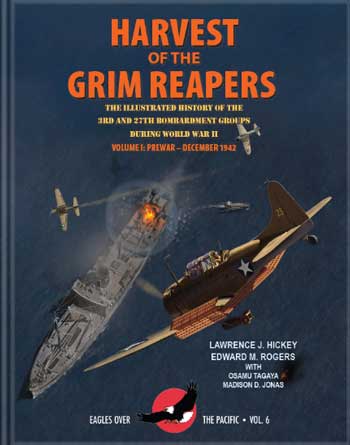
Harvest of the Grim Reapers – The Illustrated History of the 3rd and 27th Bomb Groups During WWII, Vol. 1: Prewar to Dec’42
98,00 €
With roots dating back to the air war over France in World War I, the 3rd Bomb Group would pioneer the low-level air attack strategy used in the Pacific Theater in World War II. In 1939, the unit was split up: half the personnel would make up the new 27th Bomb Group that would help defend the Philippines, while the rest would remain in the U.S. for additional training. The two units would reunite in Australia in March 1942, after two dozen 27th pilots escaped the maelstrom of the Japanese invasion of the Philippines. Bolstered by three score new pilots, and later, RAAF co-pilots and gunners, their first major combat operation was the Royce Raid, a surprise attack against the Japanese in the heart of the Philippine Islands.
Forced to adapt to an unpredictable supply line, the 3rd Bomb Group flew A-24 dive-bombers, A-20 strafer-bombers they modified themselves and B-25 medium bombers acquired from the Dutch Air Force. Major Paul I. Pappy Gunn, a future legend of the 3rd Bomb Group, was instrumental in the development of the A-20 strafer model that changed the way air units attacked the Japanese. Throughout 1942, they bombed Japanese bases at Lae, Salamaua and Buna, often without available fighter cover. Pursued by the Tainan Kokutai, a Japanese fighter unit then at its peak prowess, airmen who survived after their planes were shot down over enemy territory had to cross the untamed jungles of New Guinea while dodging Japanese troops to reach Allied territory. Their stories are told to the full extent of what information is available.
Over 700 photos, 16 page color section.
| Gewicht | 2 kg |
|---|---|
| Buchautor | |
| ISBN | |
| Seiten |