
-

Savoia-Marchetti S.79 Sparviero 1934-1947 From Airliner and Record-Breaker to Bomber and Torpedo-Bomber 1934
58,00 €In this book, aviation historian and photographer, Luigino Caliaro, presents the full story of the S.79, exploring its origins, design, development, construction and operations, as well as offering a detailed account of its civilian, twin-engine and export variants, and projected developments. The book is enhanced by hundreds of rare photographs, colour artworks and detailed technical drawings, making this the most comprehensive account of this interesting and successful aircraft to be published in the English language.
With 490 b/w pictures, 99 colour pictures and illustrations, 37 colour profiles, 72 drawings as well as 5 maps. -
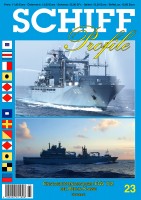
Schiff Profile, No. 23: Einsatzgruppenversorger EGV 702 der Berlin-Klasse
11,80 €This new profile covers the German support ships taking care of maintaining the operational capability of German naval ships in international missions.
-
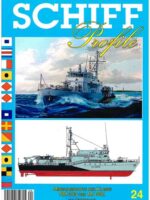
Schiff Profile, No. 24: Minenjagdboote der Klasse SM 343 und MJ33
12,80 €Where the fleet comes, we had been already there. That’s the motivation of the German mine sweepers. This issue describes the story of the minesweepers and the current types SM 343 and MJ 332, also with a lot of colour pictures (also details!).
-
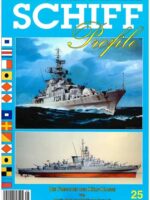
Schiff Profile, No. 25: Die Fregatten der Köln-Klasse
13,50 €The first large newbuilt ships of the young German Navy were the frigates and destroyers. In addition to the destroyers of the HAMBURG class, which are dealt with in the Schiff Profile 21, the German Navy issued from March 1957 the order for the construction of six ships of the COLOGNE class, or F-120 class, as it was later renamed.
This booklet accompanies the varied history of the frigates KÖLN, EMDEN, AUGSBURG, KALRSRUHE, LÜBECK and BRAUNSCHWEIG from the keel laying, through their mission trips to the end of their service. -
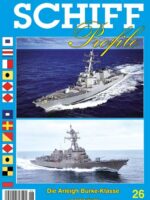
Schiff Profile, No. 26: Die Arleigh Burke-Klasse
13,80 €The Arleigh Burke class – often referred to by the US NAVY as the DDG-51 class – is a class of guided missile destroyers of the United States Navy, which have a variety of offensive and defensive capabilities. With currently 68 ships, she is in terms of the number of units one of the most numerically built ship classes of the US Navy since the Second World War and the most built since the end of the Cold War.
The best-known Arleigh Burke-class destroyer is the USS Cole, which was badly damaged in a terrorist attack in the Middle East in 2000.
You will gain a detailed insight into the development history, an overview of all 89 ships built and planned so far, as well as the technical equipment of the Arleigh Burke class.
84 colour pictures, 4 b/w pictures, 4 coloured graphics. -
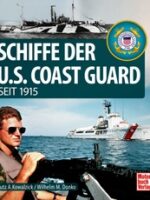
Schiffe der U.S. Coast Guard seit 1945
39,90 €The English term COAST GUARD describes a paramilitary force to protect coastal waters. By far the largest Coast Guard in the world is the U.S. Coast Guard, it corresponds in size, its fleet and its equipment to a full-fledged navy. During World War I and World War II, the U.S. Coast Guard was subordinated to the U.S. Navy, after changing affiliations, it has been part of the Department of Homeland Security since 2003.
For historical reasons, she still calls her ships CUTTERS. These ships are described here in detail, class by class, and photographically documented.
With 368 b/w and color photos, as well as tables. -
Schlachtschiff Tirpitz, Vol. 1: The beast is born. Bau und Aus- bildung (1936/Oktober – 1941/Mai)
59,95 €This first volume of a series addresses both building and fitting-out of the largest and most powerful European battleship of WWII. For this purpose, hitherto unpublished photographic material in high quality and quantity illustrates the life of this once proud and mighty warship.
After years of research and the evaluation of historic documents – such as the numerous war diaries of ships and other administrative bodies involved – nearly the entire range of photos could be associated to certain locations and their frames. Therefore the photos are chronologically arranged as if viewed in a time-lapse, from the ship’s launch in Wilhelmshaven, its fitting-out and transfer to the Baltic Sea via the narrow Kaiser-Wilhelm-Kanal (Kiel Canal) and Hitler’s visit and inspection of the ship in Gdynia (renamed Gotenhafen by the occupying Germans).
The photos are supplemented by detailed technical information and perspective illustrations depicting individual stages of fitting-out and camouflage scheme, plus maps showing the Wilhelmshaven and Gotenhafen port facilities and transfer routes in between. Furthermore, photos of past and present are shown side-by-side for comparison purposes in order to identify the individual berths and anchorages of the largest German battleship in service.
Despite having been a German warship, the battleship TIRPITZ – and of course her famous sistership BISMARCK – still receives worldwide attention today. For this reason German text and captions are accompanied by their respective English translations to make this historic period of German Kriegsmarine linguistically applicabel to non-German readers.
274 b/w pictures, 11 original color pictures, 27 color pictures of today, maps of the port facilities as well as 12 pages with renders/computer-animated color drawings. -
Schlachtschiff Tirpitz, Vol. 2: Ready for combat. Erster Kriegs- einsatz in der Ostsee (1941/Mai – 1942/Januar)
59,95 €Preface:
The second volume presented particular challenges with regard to specifying dates and locations, since the nearly four months between April 01 and July 20 of 1941 needed to be reconstructed without the help of the TIRPITZ war diary almost seventy years after the events. Therefore extensive archival work was necessary, and with the documents still in existence, such as war diaries from ships and other naval bodies, it became possible to complete missing links and to shed some light onto the life of the TIRPITZ.
A further complication arose from the fact that the battleship was often located repeatedly at the same positions, which rendered it difficult to place the photos in correct chronological order. The lengthy stay at the shipyard in Kiel had to be ordered, as well as the numerous photos showing the ship at sea for which reference points allowing immediate conclusions were lacking. In such tricky situations it became essential to pay attention to minute details on the ship, such as damage or paint irregularities on the hull, specific elevations of AA guns or striking equipment details, such as the garbage chutes that were attached to the railing in different combinations and locations. Such details made it possible to draw a link to photographic material for which the date had already been confirmed, thus allowing unfamiliar photo to be placed in correct chronological order. In some cases even this was not feasible, and there was no alternative but to provide an approximate time frame e.g. a particular month for one or other photo.
Every now and then, the weather log in the war diary was helpful in terms of wind direction, the state of the sea and weather conditions. Since entries in the diary took place in the morning, they were only partly useful for the dating process, because the weather could have changed during the day. Only lengthy periods under the influence of areas of low or high pressure were a fairly reliable means for rendering datings likely or unlikely. But the sun also provided assistance in fixing the date of photos sometimes even accurate to a specific hour or minute. With the aid of the ephemerides almanac (suns position in relation to season and the degrees of longitude/latitude) it was possible to determine the height and azimuth angles needed to deduce the time of day. In theory, this appears fairly simple, but in reality the calculations were difficult, since the dimensions of structural details were seldom known, and the lengths of shadows could only be defined when they crossed the caulking lines of the wooden deck planks at right angles. Furthermore, external influences such as ships movements due to swell or the trim of the ship or changes in course caused the ship to list, thus altering its alignment parallel to the horizon. For these reasons, calculations such as these involved considerable effort and were only applied in cases in which a relatively authentic and sound statement needed to be made with respect to the time of day determined.
In historic documentation of this kind, it is inevitable that symbols and symbolism typical of the time are made visible. However, it would be an absolute misconception to deduce from this that the authors have any sympathy for Nazi ideology. The presentation of such symbols in no way detracts from the fact that these sea-going steel giants as a means of power still hold a certain fascination, despite the inhuman and political system behind them.
Index:
1941 April 18 to May 11: Gotenhafen, Seebahnhof
1941 May 11 to 20: 2nd training phase, eastern Baltic
1941 May 21 and 22: transit from eastern Baltic to Kiel
1941 May 23 to June 02: floating dock C and berth 16
1941 June 03 to 13: 3rd training phase, central Baltic
1941 June 13: inner Firth of Kiel, mooring buoy A12
1941 June 14 to July 12: prep. for shipyard, Scheer-Hafen
1941 July 12 to Aug. 02: 2nd stay in floating dock C
1941 Aug. 02 to 27: shipyard, DWK, berth 2
1941 Aug. 27 to Sept. 01: Kiel, Scheer-Hafen
1941 Sept. 01 to 03: trials in Bay and Firth of Kiel
1941 Sept. 04 to 10: shipyard, berth 2 and Scheer-Hafen
1941 Sept. 11 to 17: western Baltic and Scheer-Hafen
1941 Sept. 17 to 22: exercises in central Baltic
1941 Sept. 23 to 24: Baltenflotte, first wartime deployment
1941 Sept. 24 to 25: anchoring at Firth of Föglö, Finland
1941 Sept. 26 to Oct. 06: Gotenhafen and Bay of Puck
1941 Oct. 06 to 31: gunnery formation exercises, cent. Baltic
1941 Oct. 31 to Dec. 01: 3rd shipyard period
1941 Dec. 02 to 19: combat training in central Baltic
1941 Dec. 20 to 1942 Jan. 11: Ghf Gulf of Danzig
1942 Jan. 11 to 14: Operation Melone, from Ghf to Schillig
Additional features:
Specifications, 15in main gun turrets Spedifications, 5.9in secondary gun turrets
Gun loading trainers
Specifications, 4.1in AA guns
Specifications, 3,7cm and 2cm AA guns
Specifications, 2cm AA quadruple guns
Specifications, G7A torpedo
General information on ship
Kiel, past and present
Gotenhafen Gdynia, past and present
Maps:
1941 Map of Firth of Kiel Scheer-Hafen DWK
1941 Sept. 11 to 16: trials dispersion firing, west. Baltic
1941 Sept. 23: route map Baltenflotte (southern section)
1941 Sept. 24: route map Baltenflotte (northern section)
1941 Sept. 24 to 25: anchorages at Firth of Föglö, Finland
1941 Oct. 06 to 31: movements in central Baltic
1942 Jan. 11 to 13: Operation Melone, from Ghf to Kiel
1942 Jan. 13 to 14: westbound to Schillig via Kiel Canal
1942 Jan. 14, afternoon: anchorages off Schillig
Graphics:
The interior of 15in main gun turrets
1941 June: fitting-out status, Kiel and central Baltic
1941 late Aug. to early Sept.: fitting-out status, Kiel
1941 Sept.: fitting-out status during Baltenflotte
1941 Sept.: camouflage of Baltenflotte (northern group)
1941 Sept. 23: anti-submarine protection of the task force
1941 Sept. 25: anti-submarine protection of the task force
1941 early Dec.: fitting-out status and camouflage, Kiel
Drawings of hull details -

Schlachtschiff Tirpitz, Vol. 3: First actions in Norway. Einsatz im Nordmeer (1942 / Januar – Juli)
59,95 €This third volume illustrates the deployment of the TIRPITZ to Norway and the stationing in the Trondheim area. Both the high quality and quantity of the hitherto unpublished photo material illustrate the life of this largest German warship.
After years of research spent on evaluating historic documents such as the war diaries and after finding the locations associated to the diary entries, it has been possible to allocate almost the entire range of photos to certain locations and time frames. History thus can be still viewed in quick motion: arrival at Faettenfjord, followed by first deployment against an Allied convoy (PQ12) and the abortion of the sortie, as well as the brief stay at the Bogenfjord near Narvik. After that return to Trondheim in order to prepare for the next operations against the Allied lines of supply.
All of this is supplemented by detailed technical information and projections depicting the individual stages of fitting-out, the camouflage patterns of the warship, as well as the operation routes along the Norwegian coastline. Furthermore, photos of the past and the present are shown side-by-side for comparison purposes in order to identify the individual mooring places of the ship. But also further units such as PRINZ EUGEN and ADMIRAL SCHEER, which were intended to operate with the TIRPITZ, have been included in order to complete the historic chain of events.
Despite having been a German warship, the TIRPITZ and her famous sistership, the BISMARCK still receives strong worldwide attention today. For this reason the German texts and captions are accompanied by their respective English translations to make this historic period of the German Kriegsmarine linguistically accessible to non-German readers.
More than 400 mostly unpublished photos, perspective representations of the fitting-out stages and the camouflage schemes of the battleship, historical maps of port facilities maps of the ships movements. -
Schlachtschiff Tirpitz, Vol. 4: Against the Allied Convoys u.a. Operation Rösselsprung 1942 / Juli – 1943 / März
59,95 €This fourth volume mainly concentrates on the largest sortie of the TIRPITZ during the summer of 1942, her deployment against the Allied convoy PQ17 in operation Rösselsprung. Both the high quality and quantity of the hitherto unpublished photo material illustrate the life of this largest German warship. After years of research spent on evaluating historic documents such as the war diaries and after finding the locations associated to the diary entries, it has been possible to allocate almost the entire range of photos to certain locations and time frames. It is again possible to view history in its chronological order from moving out of Trondheimfjord through Gimsøystraumen into Kaafjord in northern Norway. After another failure of a German undertaking in the Arctic Ocean, the task force eventually was transferred to Bogen where the TIRPITZ kept the Allied convoys in constant state of high alarm, merely as a result of her presence. In autumn 1942 the ship should return to Germany for overhauling. Despite this, Hitler ordered the ship to stay in Norway, hence several repairs had to be carried out in Lofjord, before returning to Bogen Bay in March 1943. Despite having been a German warship, the TIRPITZ and her famous sistership, the BISMARCK still receives strong worldwide attention today.
For this reason the German texts and captions are accompanied by their respective English translations to make this historic period of the German Kriegsmarine linguistically accessible to non-German readers. All of this is supplemented by detailed technical information and projections depicting the individual stages of fitting-out, the camouflage patterns of the warship as well as the operation routes. Furthermore, photos of past and present are shown side-by-side for comparison purposes in order to identify the sceneries that have not changed much until today.
476 mostly unpublished photos, perspective representations of the fitting-out stages and the camouflage schemes of the battleship, historical maps of port facilities, maps of the ships movements.
476 mostly unpublished photos, perspective representations of the fitting-out stages and the camouflage schemes of the battleship, historical maps of port facilities, maps of the ships movements. -
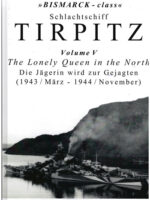
Schlachtschiff Tirpitz, Vol. 5: The Lonely Queen in the North Die Jägerin wird zur Gejagten (1943 / März – 1944 / November)
59,95 €Final Volume V describes the transformaion of the TIRPITZ from a mighty offensive weapon into a steel giant that had become more and more difficult to protect. Both the high quality and quantity of the hitherto unpublished photo material illustrate the life of the ship until its capsizing off Tromsø.
After years of research spent on evaluating historic documents such as the war diaries and after finding the locations associated to the diary entries, it has been possible to allocate almost the entire range of photos to certain locations and time frames. It is again possible to view history in its chronological order from moving to a permanent stay in northern Norway to the berthing in Kaafjord. Furthermore, the last of the large-scale sorties against the Allied weather station on Spitsbergen in Sept. 1943 is documented, as well as the near-destruction by British midget submarines. The following and more intensively conducted air strikes made the final destruction of the largest German battlship by the RAF inevitable.
All of this is supplemented by detailed technical information and projections depicting the individual stages of fitting-out, the camouflage patterns of the warship as well as the operation routes. Furthermore, photos of past and present are shown side-by-side for comparison purposes in order to identify the sceneries that have not changed much until today.
Despite having been a German warship, the TIRPITZ and her famous sistership, the BISMARCK still receives strong worldwide attention today. For this reason the German texts and captions are accompanied by their respective English translations to make this historic period of the German Kriegsmarine linguistically accessible to non-German readers.
Throughout illustraged with b/w pictures, color pictures from today as well as coloured cumputer-animated illustrations. -
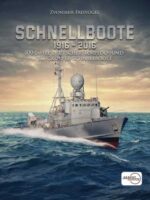
Schnellboote 1916 – 2016. 100 Jahre deutscher Torpedo- und Flugkörper-Schnellboote
45,00 €The Schnellboote were not often described in detail by the Anglo-American naval authors, and even the origin of the designation E-boats is not completely clear. It is believed that the meaning was “Enemy Boats”, but there were other German vessels belonging to the “boat” category (like the motor minesweepers, called R-Boote by the Germans and R-boats by the Allies, or minesweepers aka M–Boote/M-boats). Thus it is possible that the initial meaning was simply Express Boats, similar to Express Trains (Schnellzüge in German), and later the origin of the name was forgotten.
The book Schnellboote, written by the already well-known naval author Zvonimir Freivogel, is divided into four parts, the first is about the genesis and the development of this warship category in Germany, the second an overview of all S-boat operations on the European war theaters between 1939 and 1945, the third is describing these vessels in the Bundesmarine, and the fourth is a short history of S-boats in the Volksmarine. The book is richly illustrated with over 200 photographs, drawings, and charts, and there are numerous tables with technical and building data, together with fates of all German wartime or post-war fast attack craft. -

Schwenkflügelflugzeuge
34,90 €Swing-wing aircraft are a very special phenomenon in the sky and have lost none of their fascination to this day, as they are among the most powerful and complex constructions in military aviation. Legendary machines such as the American F-111, the F-14 Tomcat, the Russian MiG-23, Su-24, the huge Tu-22M, Tu-160 or the European all-rounder Tornado: Heiko Thiesler describes these and other types in his new volume again with a lot of unseen image material, expert texts and meaningful tables. A cutting-edge reference book for every aviation enthusiast.
With 210 images. -

Schwere Sowietische Panzer 1930-1945
34,90 €In this volume, the author focuses on the heavy tanks of the Soviets, which were built from 1939 to 1945. He describes not only the main types T-35, T-100, the KW and JS series, but also numerous variants. In addition, he discusses the development and the operational history of the types.
-

Schwerlasttransporter Elefant 2 & Mammut. WalkAround & InAction. WalkAroundSeries No. 1003
17,95 €This WalkAround & InAction booklet deals with the heavy-duty transporters Elefant 2 and Mammut of the Bundeswehr in action and in detail.
In addition to the tractors, the associated semitrailers are shown.
These are the semitrailers 30 tons. telescopic, the semitrailer 70 tons, the new semitrailer 70 tonnes. 8-axle truck and the Kässbohrer semitrailer 50 to.
Of course, the corresponding prototypes will also be presented.
In addition to a short, historical introduction, the technical details, vehicle combinations, possible applications, etc. are presented with many pictures.
In this illustrated book, the Elefant 2 is shown in detail for the first time.
With 308 color photos. -
Seaforth World Naval Review 2022
49,95 €For more than a decade this annual volume has provided an authoritative summary of all that has happened to the world’s navies and their ships in the previous twelve months. It combines regional surveys with major articles on important new warships, and looks at wider issues of significance to navies such as aviation and weaponry. The contributors come from around the globe and as well as providing a balanced picture of naval developments, they interpret their significance and explain their context.
As well as its regular regional reviews, the 2022 volume focusses on three fleets: the Sri Lankan Navy, the Spanish Navy and the Royal Navy. There are in-depth articles on the Argentinian Bouchard Class OPVs, the Russian Project 20380 Stereguschchiy Class corvettes, and the Royal Navy’s Batch 2 ‚River‘ Class OPVs. The technological section looks at optronic systems and offboard mine countermeasures, and there is the regular review of what is happening in naval aviation, which includes coverage of the US Marine/Navy MV-22 tiltrotor.
Now firmly established as the only annual naval overview of its type in the world, The Seaforth World Naval Review is essential reading for professional and enthusiast alike. It takes the reader to the heart of contemporary maritime affairs.
With 200 b/w and colour pictures. -
Seaforth World Naval Review 2023
49,95 €For over a decade this annual has provided an authoritative summary of all that has happened in the naval world in the previous twelve months, combining regional surveys with one-off major articles on noteworthy new ships and other important developments. Besides the latest warship projects, it also looks at wider issues of significance to navies, such as aviation and weaponry, and calls on expertise from around the globe to give a balanced picture of what is going on and to interpret its significance.
This years edition has a strong American emphasis with one of the Fleet Reviews dedicated to the US Navy, and the latest of the in-depth Significant Ships series covering the US Navys iconic Nimitz class aircraft carriers, now approaching half a century of service. Other Significant Ships include New Zealands new logistic support ship Aotearoa, and Frances Suffren class nuclear attack submarines. Technological subjects range from the currently very topical issue of Hypersonic Weapons by Norman Friedman to the Royal Navys Technological Transformation Programme, as well as David Hobbs regular review of naval aviation which this year takes in an anlysis of HMS Queen Elizabeths worldwide CSG21 deployment. -
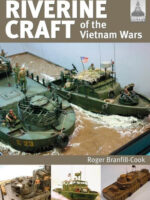
ShipCraft 26: Riverine Craft of the Vietnam Wars
22,95 €The ShipCraft series provides in-depth information about building and modifying model kits of famous warship types. Lavishly illustrated, each book takes the modeller through a brief history of the subject, highlighting differences between ships and changes in their appearance over their careers. This includes paint schemes and camouflage, featuring colour profiles and highly detailed line drawings and scale plans. The modelling section reviews the strengths and weaknesses of available kits, lists commercial accessory sets for super-detailing of the subjects, and provides hints on modifying and improving the basic kit. This is followed by an extensive photographic gallery of selected high-quality models in a variety of scales, and the book concludes with a section on research references books, monographs, large-scale plans and relevant websites.
This volume is something of a departure for the series in covering a wide variety of the types, at first improvised and then purpose-built for the Brown Water conflict. Besides the well-known American involvement, the book also covers some of the craft used by the French in their earlier struggle with Vietnamese guerrillas.
With its unparalleled level of visual information paint schemes, models, line drawings and photographs this book is simply the best reference for any modelmaker setting out to build one of these unusual craft. -
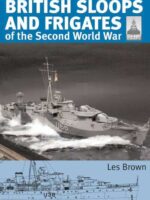
ShipCraft 27: British Sloops and Frigates of the Second World War
24,95 €This volume covers the majority of British wartime escort classes, from the inter-war ASW and minesweeping sloops that culminated in the superb Black Swan class, to the wartime designs that were originally known as ‘twin-screw corvettes’ but were eventually classed as frigates – the ‘River’ class, and their derivatives of the ‘Loch/Bay’ classes that were modified for prefabricated construction. Also included are the American-built destroyer escorts which became RN ‘Captains’ class frigates and the earlier ex-US Coast Guard cutters that were listed as sloops.
With its unparalleled level of visual information – paint schemes, models, line drawings and photographs – this book is simply the best reference for any modelmaker setting out to build any of these numerous escort types. -
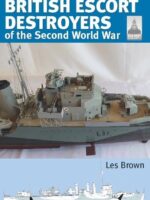
ShipCraft 28: British Escort Destroyers ot the Second World War
24,95 €The ‚ShipCraft’ series provides in-depth information about building and modifying model kits of famous warship types. Lavishly illustrated, each book takes the modeller through a brief history of the subject, highlighting differences between ships and changes in their appearance over their careers. This includes paint schemes and camouflage, featuring colour profiles and highly detailed line drawings and scale plans. The modelling section reviews the strengths and weaknesses of available kits, lists commercial accessory sets for super-detailing of the subjects, and provides hints on modifying and improving the basic kit. This is followed by an extensive photographic gallery of selected high-quality models in a variety of scales, and the book concludes with a section on research references – books, monographs, large-scale plans and relevant websites.
This volume covers the many variations of Royal Navy wartime escort destroyers, both the purpose-built ‘Hunt’ class and the conversions from older fleet destroyers. The ‘Hunts’ were built in four groups (Types I to IV), while the old ‘V&W’ classes were modified to Long Range Escort, Short Range Escort and ‘Wair’ (anti-aircraft) variants. Also included are the fifty ex-US ‘flush-deckers’ that became the ‘Town’ class.
With its unparalleled level of visual information – paint schemes, models, line drawings and photographs – this book is simply the best reference for any modelmaker setting out to build any of these numerous escort types.