-
Kronstadt, das Festungstor nach St. Petersburg
28,50 €Immediately after the founding of the new Russian capital St. Petersburg in 1703, not only the city, which still was under construction, had to be secured against maritime attackers, but also the Neva estuary in the Gulf of Finland. The result was a gigantic reconstruction program that extended well into the First World War.
With 89 illustrations (also some colour pictures of 2007). -

KUNO AG Werk I. Die Endmontage der Messerschmitt Me 262 und die Rolle des KZ-Außenlagers Burgau
39,00 €The book deals with the circumstances of the relocation of the Messerschmitt A. G. to Burgau in Swabia, the construction of the Waldwerk (= plant) Kuno I and the living conditions of the more than 1,000 Jews in the Burgau subcamp.
With many b/w pictures, documents… -

L‘ Artillerie Antichar Allemande Durant La Seconde Guerre Mondiale
42,80 €The book deals with the German anti-tank with a focus on the 2nd World War and shows the development of anti-tank guns and ammunition/grenades until 1945 (8,8 Flak, Sd.KfZ 6 + 8, 3,7cm Pak 35/36, 7,5cm Pak 40, 5cm Pak 38, 5cm Panzerjägerkanone 38, 12,8cm K.44…) as well as the tractors.
181 b/w pictures, 100 b/w drawings and 43 colour profiles. -
La Luftwaffe en Belgique, Tome I. Conquête et installation Collection Histoire des Unités n°15
54,00 €From September 1939 and throughout the ‚Funny War‘, the airspace of neutral Belgium was criss-crossed by belligerent aircraft taking advantage of the weakness of Military Aeronautics. German reconnaissance planes were thus able to identify future invasion routes. On May 10, 1940, the Wehrmacht entered the country and, until the end of that month, fighting raged in the Belgian sky, which had become a major strategic challenge for the invaders. With the withdrawal of the British expeditionary force, air engagements became rare (although still active in France) which allowed the Luftwaffe services to establish themselves very quickly in the country to restore the airfields as well as the military structures that could serve them.
After the French capitulation at the end of June 1940, Belgium experienced little daylight air combat, whether during the Battle of Britain or the Non-Stop Offensive in 1941, being ‚protected‘ by the distance separating it from the RAF fighter bases. At most, ships and a few ports became the targets of the British air force.
On the other hand, Belgium was (like the Netherlands) on one of the direct routes taken by the aircraft of Bomber Command leaving at night to attack the factories of the Ruhr. Hence the rapid establishment in the country of night fighter units (Nachtjagd) which were to make a name for themselves (the famous ‚Ghosts of Saint-Trond‘ feared by the crews of the RAF).
The period 1939-1942 was therefore contrasted with bloody fighting during the offensive in the west followed by relative tranquility in the Belgian skies only disturbed by a rise in power of Bomber Command. The few intrusions of the heavy Americans in 1942 remained anecdotal although harbingers of a growing threat.
With about 550 photos. -
La Luftwaffe en Belgique, Tome II. Fighting escalation and withdrawal. Collection Histoire des Unités n°16
54,00 €In 1941-1942, if we do not take into account the night operations of Bomber Command, the air war ultimately had little effect on Belgium. 1943, the pivotal year of the Second World War, was however marked for this country by the increasing intrusion of the ‚Viermots‘ of the American VIIIth Airforce who, until then, had shown little expression in its airspace.
Since 6th of April 1943, the population discovered the deadly power of the ‚Flying Fortresses‘ during the bloody bombing of Mortsel. On this occasion, we could apprehend the local weakness of the Tagjagd (day hunt). Despite a regular call to hunters based in the vicinity or temporary transfers of portions of Jagdeschwader, the German hunt (supported by the Flak) could hardly contain the assaults of the USAAF.
Since the first quarter of 1944, when American fighters now had autonomy to fly over Reich territory, the daytime defense of the Belgian defensive glacis collapsed and aerial combat in the Belgian sky turned into bloody setbacks for a Tagjagd still present but numerically dominated.
Despite its important successes and the strengthening of its structures (such as the entry into service of the Florennes airfield at the beginning of 1943), the Nachtjagd in turn suffered the law of numbers and it was probably during the last quarter of 1943 that its aircraft lost the game. Although fighting foot to foot, the Nachtjäger could no longer seriously block the British four-engine fleets going to bomb the Reich.
The ordeal of the Luftwaffe in Belgium continued in 1944 until the evacuation of the country in September 1944.
However, aerial fighting continued sporadically in the east of the country, culminating in December 1944 with the outbreak of the ‚Battle of the Bulge‘. But, despite the efforts and sacrifices made, the Luftwaffe was no longer able to carry any decision (as was the case on 1 January 1945 during Operation Bodenplatte).
In 1945, pushed back to the east, the German aircraft rarely manifested themselves on Belgium, the last of them seeming to have been lost on March 30 at Saint-Géry.
With more than 550 b/w pictures!! -
-

Landungsschiffe der U.S. Navy seit 1939
29,90 €Landing ships have a permanent place in the American fleet today. They stand as a separate genus between the combat and auxiliary ships. In WW II they became so important. The richly illustrated type book by Wilhelm M. Donko offers an overview of this diverse and varied ship category, without them a global safety concept would not be enforceable: Over 2000 landing ships of the American Navy are listed in detail according to types and classes. The focus is on the approx. 600 amphibious mother ships of the U.S. Navy.
With about 300 photos. -

Large Cruisers of the German Imperial Navy
45,00 €From a total of fifteen Large Cruisers of the German Imperial Navy, six vessels were large cruisers protected by an armored deck only, with other nine being armored cruisers. From the latter category two prototypes were built, followed by three series of two ships each, and by one final single vessel, that represented the zenith of this type built for the Imperial Navy. Six oldest protected cruisers were removed from the frontline service early in the WW I, but from nine armored cruisers six were sunk during the war, with two best-known Scharnhorst and Gneisenau being lost in the South Atlantic, and the newest armored cruiser Blücher during a battle in the North Sea, also fighting against a more powerful adversary, the battlecruisers.
The already well-known maritime author Zvonimir Freivogel is in this richly illustrated book describing the development of the German and foreign armored cruisers as well, the vessels that were having their zenith in the late 19th and early 20th Century, to be made obsolete by the battlecruisers. In addition to the overview of technical data of the German Large Cruisers (from Kaiserin Augusta to Blücher), their less-known missions, as they also took part at international Missions, and their training cruises on all WorldŽs oceans before the WW I are listed in detail, together with the operations executed during the war and with their final fates.
With 221 illustrations. -
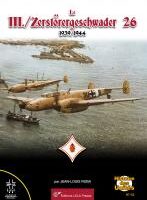
Le III./Zerstörergeschwader 26 – 1939/1944. NEUAUFLAGE!
39,95 €It may seem surprising in the context of an air unit history to detach a group from its squadron. However, the III./ZG 26, which started the Second World War on Bf 109, had a very independent career. Having received twin BF 110s during the Funny War, the unit was largely engaged in 1940 in the west and on England. Released at the end of 1940, like all Zerstörer groups, the III./ZG 26 was sent to the Mediterranean in early 1941, where his heavy fighters mainly supported the advance of the Afrika Korps while escorting ships supplying the German Army. Africa. In 1943, after the fall of Tunisia and facing the numerical superiority of Allied aviation, the III./ZG 26 returned to Germany to be thrown into the bloody fighting of the Reichsverteidigung. The Bf 110 were decimated and the unit was dissolved in mid-44.
With 380 photos and 28 color profiles. -
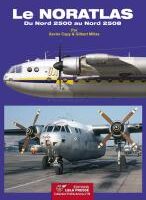
Le Noratlas. Du Nord 2500 au Nord 2508 Profils Avions No. 29
59,95 €Inspired by a first edition published in 1997, this is a new presentation, greatly enriched, with a totally renovated photographic choices.
This book traces precisely the career of the Nord 2501 Noratlas from its conception at the end of the 40s until its withdrawal from the final service in the late 80s. Many versions tailored to specific needs were extrapolated, including electronic warfare.
Also reviewed are foreign military users (Germany, Israel, Portugal, Greece, and many African countries), and some civilian companies like UAT and Air Algeria who passed command of the North 2502 versions with extra reactors. Nord Aviation tried to find other opportunities with N.2503 versions, N.2506, N.2508, but too late to be successful.
6 maps, 23 color profiles, 8 b/w drawings as well as a complete production list. More than 1000 photos! -

Leopard 2 in der Bundeswehr. Entwicklung, Einsatz und alle Varianten des Kampfpanzers Leopard 2
69,00 €The Leopard 2 is a legend. Today, due to dramatic developments on NATOs eastern flank, the tank is back in the forefront of military weapon systems for land forces. Although it has been in service for more than 43 years, the German Leopard 2 main battle tank and its associated family of vehicles remain the first choice of 20+ user nations today, underlining the vehicles leading role among armoured formations worldwide, well ahead of other nations designs.
With this book Leopard 2 in German Service, the publisher and author would like to pay tribute to this chapter in German military vehicle history with the most up-to-date and most comprehensive monograph on this topic.
It contains all Leopard 2 main battle tank production batches and Leopard 2-based combat support vehicles of the German Bundeswehr.
Inportant note: This title is a reprint of the first 320 pages of the Leopard 2 The Full Story containing all German Army variants yet without all foreign Leopards.
On 320 pages this publication is illustrated with 602 colour photographs and 100 graphics plus a foldout with 1/35 scale line-drawings of the newest addition to the range, the Leopard 2A7V!
Full English text, LIMITED EDITION: 999 copies -
Leopard 2A6. Portuguese Army in Field Manoeuvres
24,95 €This In-the-Field book looks at the Leopard 2A6 in Portuguese Army service.
It illustrates the Leopard on exercise alongside other arms and vehicles of the Portuguese Army.
We see it in the field, on the live firing range as well as on parade and during maintenance.
Support vehicles are also covered as well as crew uniforms and insignia/badges, plus a short walkaround of the Portuguese 2A6.
With approximately 220 photographs.
Now available again as a revised edition with updated information, 2 new pages and additional photographs. -
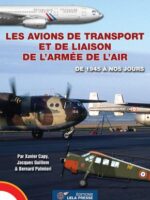
Les Avions de Transport et de Liaison de l’Armée de l’Air de 1945 à nos jours
79,95 €After the carriers of the Air Force have been involved in all foreign operations since 1945, it therefore was only fair to finally bring together all these planes and their units, over 75 years of history, across all continents. Not only transport planes, but also all those that have been used for links, single or twin, in a role that was not always foreseen during their design …
The first part of the book reviews all transport, liaison, in-flight refueling and specific mission planes (electronic warfare, search and rescue, calibration, etc.). The second part gathers and presents all the units of the Air Force having implemented these devices, in metropolitan France as in theaters of operations. Thus, all the planes designed from the start for transport are presented in detail (design, use, particularities …), as well as their modified versions for training and specific missions (electronic warfare, search and rescue, calibration …), without forgetting the aircraft whose initial vocation was in no way transport or liaison. This is how we will see in these pages some models of famous bombers which enjoyed a second career in transport after the war.
At the same time, all the units with a transport vocation (and similar), but also those for training and specific missions are detailed (chronology, traditions, endowment …).
This book, of more than 470 pages, illustrated with some 600 photographs and 17 unpublished color profiles, is not for all that dedicated to military air transport stricto sensu and the air tankers of the Strategic Air Forces are not omitted, as well as the technical units that have always supported Air Force carriers. -

Les Junkers Ju-52 et AAC.1 Toucan sous nos Cocardes Collection Profils Avions N°38
59,95 €Thanks to its reliability and robustness, the Ju-52 was a great success: more than 4200 examples were produced for Germany, but also 170 examples were built in Spain with the designation Casa 352.
In France, 538 machines were still produced in the Amiot factories under German occupation. The Ju-52 was so well designed that in 1944, when the German armies withdrew, it was decided to continue production under the designation AAC.1:
The aim was to increase rapidly the air transport capacity of the armies. In the works of the Ateliers Aéronautiques de Colombes (AAC), 415 AAC-1s with the name Toucan were produced.
The detailed text is supplemented by 800 photos and 50 color profiles. -
-

Liberty Factory. The untold story of Henry Kaiser’s Oregon shipyards
49,95 €Churchill famously claimed that the only thing that had really frightened him during the war was the Battle of the Atlantic. Keeping open the lifeline between the US arsenal of democracy and the UK was essential to preparations for the invasion of Europe and in the final analysis this came down to building merchant ships faster than German U-boats could sink them.
Crucial to this achievement was the Liberty ship, a simple freighter that could be built rapidly, combined with the untapped industrial potential of the USA that could build them in vast numbers. Undoubtedly the most important individual in the rapid expansion of US wartime shipyard capacity was Henry Kaiser, a man with no previous shipbuilding experience but an entrepreneur of vision and drive. This book tells the story of how he established huge new yards using novel mass-production techniques in the most surprising location Oregon, one of the least industrially developed areas of the US and one without an existing pool of skilled labour to draw on.
It was not just the yards that were revolutionary, as the Kaiser companies provided housing, health and welfare benefits that attracted workers from all over the country, including women recruited into an industrial workplace for the first time. This well-motivated workforce turned the Kaiser yards into the most efficient shipbuilders in the country. In total Kaisers Oregon yards built over 450 Liberties and the follow-on Victory ships including one built in the record time of 10 days as well as around 150 tankers, some 50 escort carriers and countless amphibious warfare ships. Curiously, this truly remarkable achievement, of huge significance to the eventual Allied victory, has been consigned to the footnotes of history, but is fully documented and celebrated for the first time in this book.
200 b/w illustrations. -

Life & Death on the Eastern Front. The Rare Colour Photographs from the Second World War
37,95 €This incredible visual record of life and death along the Eastern Front draws from the PIXPAST Archive, a collection built by Ian Spring of more than 32,000 original colour photographs taken between 1936 and 1946. Collated into three parts and organised thematically, the book begins with images of the ground war, including Hitlers invasion of the Soviet Union and the tanks, vehicles, weaponry and infantry on both sides.
Moving into the war in the skies, the images depict aircraft in flight and on the ground, the bombers, fighters, Luftwaffe personnel and the destruction wrought from battle. And finally, the images take us behind the lines, to the prisoners of war, partisans, medics, the daily lives and leisure activities of soldiers and civilians along the front and the impact of the harsh Russian winter.
With 250 photographs and text by renowned author and commentator Anthony Tucker-Jones, these images offer a rare, often surprising insight into the realities of the Second World War and people caught up in it, in vivid colour detail. -

Lockheed Model 9B Orion. The Swiss Revolution
36,80 €The Few will be a series of titles where the focus will be on airliners that were only built or operated in a few numbers and flew for a particular airline. This book about the Lockheed Model 9B Orion operated by Swissair is the first title in this series.
At the time of the introduction in Europe of the Lockheed Model 9B Orion, most airliners in service flew at an easy pace of 140km/h. Swissair, the national airline of Switzerland, introduced now an aircraft that could fly at a speed of maximum 360km/h, but the usual cruising speed was around 260 to 280km/h. Nevertheless, the little wooden wonder from the USA flew 50% faster than any other aircraft a revolution in European aviation. Swissair decided to operate the aircraft with just four passenger seats, as mail was far more important and lucrative to carry.
In this book, the author has described the history of the aircraft with many new details and 147 photographs. Hubert Cance has made a cutaway of the aircraft, while Toni Ruffiner made 14 colour profiles. -

Lommen und Buxer. Volkstümlicher Schiffbau in Ost- und West- preußen.
29,90 €This book, illustrated 229 photographs and detail drawings, as well a 2 tables with skatches in 1:50 scale, covers all the different variants of the traditional East- and West Prussian sailing ships, called Lommen and Buxer.